NOW ACCEPTING PHS-C APPLICATIONS
OB Rehab Training in Acute Care and Home Health
We train professionals to enhance maternal and infant care in the hospital and home with Occupational and Physical Therapy
Welcome to Enhanced Recovery After Delivery®
Enhanced Recovery After Delivery® training develops clinical leaders who drive maternal rehab program development across health systems and empowers business owners to create new service lines that deliver earlier support for families during pregnancy and the early postpartum period.
Pelvic Health Business Owner, PHS-C Recipient
Therapists who complete ERAD® have:
- Been promoted to clinical lead positions
- Received health system awards
- Been recognized by hospital administrators
- Implemented rehab across multiple hospitals in their region
- Expanded their business by launching in-home postpartum rehab programs
- Added virtual care services to reach families earlier after birth
Acute Perinatal Rehab Training
Choose Your Training Path: 2 Options
Clinical Training vs Program Implementation
Clinicians enter the ERAD® programs at two stages: 1) Applying the early intervention model to patient care and 2) Leading the implementation of maternal rehabilitation services to bridge gaps in care.
- 1) ERAD® 15-Hour CEU Certificate Training: Learn the ERAD® clinical model used to deliver early maternal rehabilitation before and after birth. Clinicians leave this training with a framework for evaluating and supporting patients during pregnancy and the early postpartum period using immediate strategies to integrate rehabilitation services into hospital, home health, telehealth, and outpatient care.
- 2) ERAD® 30-Hour PHS Certification Program: An advanced certification for clinicians who want to lead the development of maternal rehabilitation services in their organization. Participants complete the PHS-C Implementation Project with faculty guidance while designing or expanding maternal rehabilitation pathways within their clinical setting. Graduates leave the program with a completed implementation plan or active program that supports early rehabilitation from the maternity hospital to the community.
Implementation Projects in Progress:
Clinicians enrolled in the PHS-C program are currently developing maternal rehabilitation initiatives across multiple care settings, including:
- Establishing inpatient OT/PT consult pathways after cesarean delivery
- Developing high-risk pregnancy mobility programs during maternity hospital stays
- Developing rehabilitation support for mothers with infants in the NICU
- Implementing postpartum functional screening prior to hospital discharge
- Creating interdisciplinary education programs for OB/GYN teams and maternity nurses
- Launching home health rehabilitation services after birth and maternal surgery
- Implementing telehealth postpartum recovery programs during the fourth trimester
- Creating hospital-to-outpatient referral pathways for postpartum recovery
Clinician Feedback
Option 1: 3 Months | 15-Hour Certificate Training
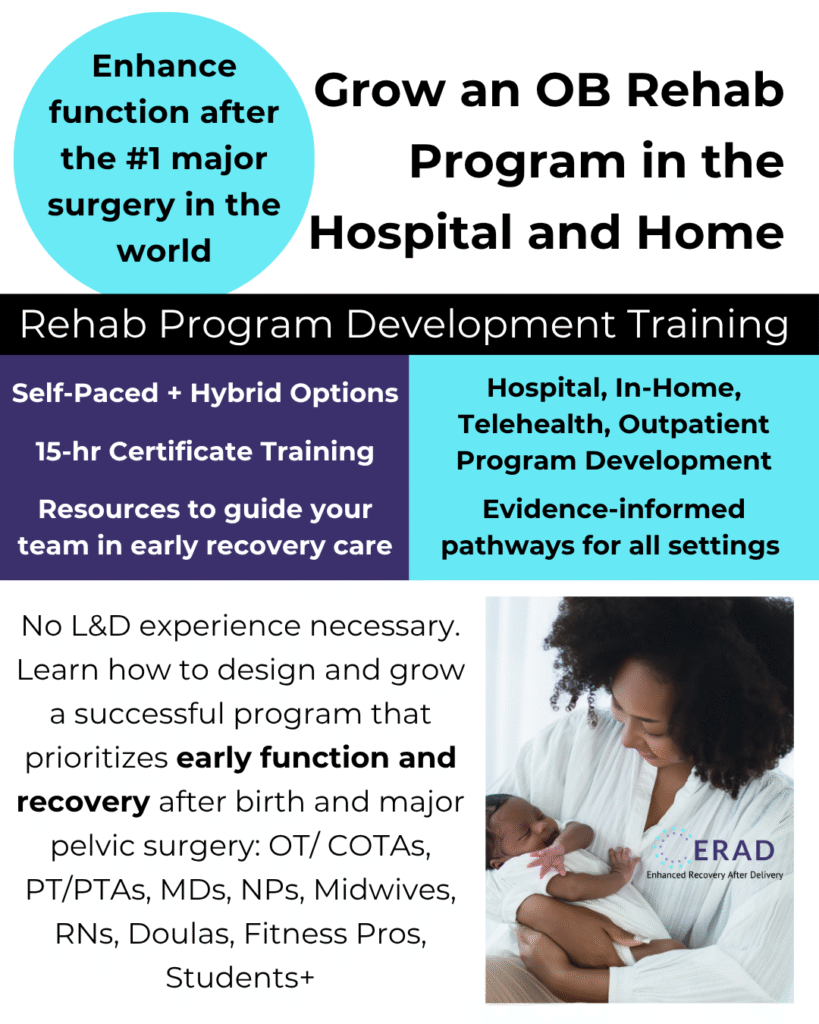
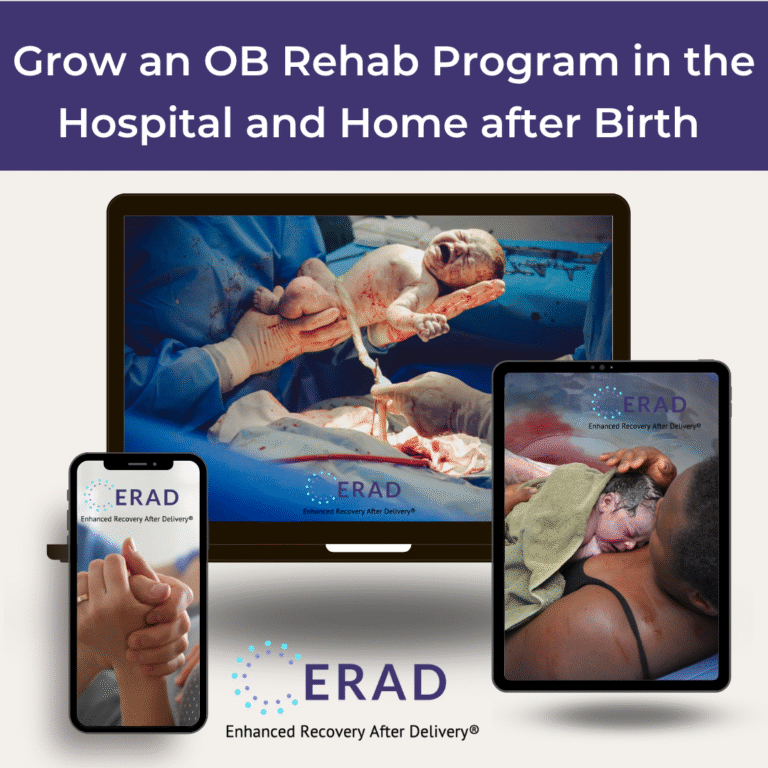
Grow an OB Rehab Program in the Hospital and Home after Birth
Self-Paced and Hybrid Training to Accelerate Your Practice in the Hospital and Home
This 15-hour certificate training prepares clinicians to grow maternal rehabilitation services in hospitals and communities before and after birth and to successfully meet the requirements for the advanced Perinatal Health Specialist Certification program and exam.
SELF-PACED (S) & HYBRID (H) PROGRAM DEVELOPMENT TRAINING
3-Month 15-Hour CEU Certificate Training
1:1 Consultation with an ERAD® Instructor
TWO PATHWAYS
1. 15-Hour Self-Paced Enrollment Pathway: Year-Round
2. 15-Hour Hybrid Enrollment Pathway: In-Person Full Day Lab
a. Hybrid Fall Lab: Saturday, September 12, 2026
b. *Discount with Texas Occupational Therapy Association: Friday, November 13, 2026
Training Objectives
Professionals will be able to create obstetric rehab programs that:
- Teach birth recovery workshops during pregnancy and build referral pathways through doulas, midwives, OB/GYNs, and childbirth educators
- Leverage communication to improve awareness of early rehab during pregnancy and after birth to optimize 4th trimester recovery and return to activity
- Develop a system where every person has access to a rehab evaluation within 24-48 hours of their birth or pelvic surgery to improve infant bonding, sleep health, mental health, and physical recovery
- Empower patients and clients to manage their recovery to avoid unnecessary complications after vaginal delivery, cesarean section, or hysterectomy at the time of birth
- Enhance patient autonomy and early function in the hospital and home with interventions for pelvic girdle and back pain, symphysis pubis dysfunction, diastasis recti, and cesarean wound healing
- Provide interventions for an extended hospital length of stay to address physical and mental health concerns in the high-risk pregnancy population
- Reduce postpartum risk factors associated with cardiovascular impairments, pelvic floor dysfunction, cesarean wound complications, and hospital readmissions
- Collaborate with clients on optimal newborn feeding positions, body mechanics for newborn care, energy conservation, and modifications to ADLs to enhance postpartum function with activity
- Successfully support families with trauma-informed care following birth complications, NICU admission, perinatal loss, and risk factors associated with social determinants of health
Sign up for the Pelvic Health Network Member Discount: HERE
Pathway 2: 6 Months | 30-Hour Certification Program
Certified Perinatal Health Specialist Program (PHS-C)
30-Hour Perinatal Health Specialist Certification Program
6-Months of Faculty Guidance on a Maternal Rehab Implementation Project-
30-hour CEU Program for the Perinatal Health Specialist Certification is divided into 3 high-demand practice areas:
-
1. High-Risk Perinatal Rehab, Hospital and Home: Perinatal anatomy and physiology, fetal conditions, maternal morbidity and health education, antepartum rehab evaluation and interventions, Obstetrics ED and ICU management, and collaboration with the maternal-fetal care team
-
2. Postpartum Rehab, Hospital Admission: Acute rehab eval and treatment within 24-48 hours of vaginal and cesarean delivery; management of immediate postpartum complications e.g. hemorrhage, perineal and abdominal wounds, pelvic girdle pain, hypertensive disorders, and pelvic health concerns
-
3. Postpartum Rehab 0-6 Weeks, Home and Virtual: Postpartum home and virtual care interventions, collaboration with birth professionals and coordination of external resources, multidisciplinary management of breastfeeding support, perinatal mental health concerns, and business/practice growth strategies
-
PHS-C Implementation Project with ERAD® faculty guidance to develop or expand a maternal rehabilitation service in your practice setting and prep for PHS Certification exam: Patient case discussions and Q/A to assist clinicians with their Perinatal Health Case Study Assignment and with navigating unique challenges when developing an obstetrics rehab or virtual practice in the hospital, home, or community
-
PHS Certification exam at the end of each cohort is offered remotely: Case Study Assignment is due prior to sitting for the exam and a passing score of 80% or greater is required to receive your certification and use the designation, Perinatal Health Specialist (PHS-C) to distinguish practice with acute, high-risk pregnant, and postpartum populations
-
Participants will be prepared to develop an OB rehab and training program in the hospital and home that serves individuals and their families during:
-
High-risk pregnancy including safe activities and exercises to enhance function
-
Within 24 - 48 hours after vaginal delivery including preeclampsia risk reduction
-
Immediately after cesarean section, cesarean hysterectomy, and pelvic surgery
-
Traumatic birth, perinatal loss, obstetrics emergency, and obstetrics ICU admission
-
During NICU admission and early infant care management
-
Following perineal tears, cesarean wound events, symphysis pubis dysfunction, pelvic girdle dysfunction, and more
PHS Certification: 2 Steps
- Step 1: Complete the 30-hour Enhanced Recovery After Delivery® (ERAD) PHS Certification Program
- Step 2: Take the PHS Certification exam with a minimum passing score of 80%
30-Hour Perinatal Health Specialist Certification Program: Two Cohorts Per Year
- I. SPRING Cohort: January - June 2026
- 15-hr ERAD® CEU course: Self-Paced or Hybrid
- 15-hr PHS-C advanced training: Hybrid
- PHS-C exam opens: May 1, 2026
- PHS-C exam closes: May 30, 2026
- Exam results: June 12 - 19, 2026
- II. FALL Cohort: July - December 2026
- 15-hr ERAD® CEU training: Self-Paced or Hybrid
- 15-hr PHS-C advanced training: Hybrid
- PHS-C exam opens: November 1, 2026
- PHS-C exam closes: November 30, 2026
- Exam results: December 11 - 18, 2026
The Perinatal Health Specialist Certification does not grant, extend, or replace any professional license and does not alter any legal scope of practice. PHS-C Recipients remain responsible for practicing within the laws and regulations governing their profession and jurisdiction.
Sign up for the Pelvic Health Network Member Discount: HERE
Registration
Self-Paced (S) 15-Hr ERAD® Training
-
Year-Round Enrollment: Self-Paced Training
-
Patient Case Study Assignment
-
3-Month Rehab Program Development Support
Hybrid (H) 15-Hr ERAD® Training
-
In-Person Lab: Spring 2026 and Fall 2026
-
FALL: September 12, 2026, Colorado Springs, CO
-
SPRING: TBD 2027, Colorado Springs, CO
30-Hr Self-Paced (S) PHS-C Program
-
PHS-C 2026 application: Closes October 1, 2026
-
15-hour ERAD® Training: Self-Paced – No Lab
-
15-hour Advanced Topics: Faculty Guidance
-
PHS Certification Exam: May 2026
(S) 30-Hr PHS-C Two-Payment Plan
-
PHS-C 2026 application: Closes October 1, 2026
-
15-hour ERAD® Training: Self-Paced – No Lab
-
15-hour Advanced Topics: Faculty Guidance
-
PHS Certification Exam: May 2026
30-Hr Hybrid PHS-C Program with Lab
-
PHS-C 2026 application: Closes October 1, 2026
-
15-hour ERAD® Training: Hybrid (H) + Lab
-
15-hour Advanced Topics: Faculty Guidance
-
PHS Certification Exam: May 2026
(H) 30-Hr PHS-C Two-Payment Plan
-
PHS-C 2026 application: Closes October 1, 2026
-
15-hour ERAD® Training: Hybrid (H) + Lab
-
15-hour Advanced Topics: Faculty Guidance
-
PHS Certification Exam: May 2026
Sign up for the 30% Pelvic Health Network Member Discount: Click HERE
Apply for the Trauma-Informed Maternal Health Scholarship: Click HERE
To review the training agreement, click HERE.
Enhanced Recovery and Wellness, LLC is an AOTA Approved Provider of professional development. Activity approval ID# 05406 and 08145. The live, blended/hybrid, distance learning-interactive, and distance learning-independent activities are offered at 1.5 and 3 CEUs, respectively, intermediate level, OT Service Delivery. The assignment of AOTA CEUs does not imply endorsement of specific course content, products, or clinical procedures by AOTA. The 15-hour Enhanced Recovery After Delivery® training has been approved by the Texas Board of Physical Therapy Examiners for 15.00 CCUs for PTs and PTAs with a course approval number of 81236TX and approved for 1.5 CEUs for PTs and PTAs by the California Physical Therapy Association with a course approval number of CPTA #26-101.
2 Steps to become a Certified Perinatal Health Specialist (PHS)
Step 1: Complete the 15-hr Enhanced Recovery After Delivery® Certificate Training and the 15-hr PHS-C Advanced Training
Requirements for 15-hr ERAD® & 30-hr PHS-C Trainings:
- Patient Case Study Assignment on rehab interventions and care collaboration during high-risk pregnancy or within 0 – 6 weeks after birth
Step 2: Take the remote Perinatal Health Specialist Certification Exam with a passing score of 80% or higher
Requirements for 30-hr PHS-C Program:
- Current CPR/AED certification and health professional licensure: e.g. OT, PT, COTA, PTA, DC, RN, NP, CM, DO, MD
- Implementation Project with ERAD® Faculty Guidance
To view CEU information, CLICK HERE
The Experience
What mothers say about early rehab after birth
Why Clinicians Love ERAD®
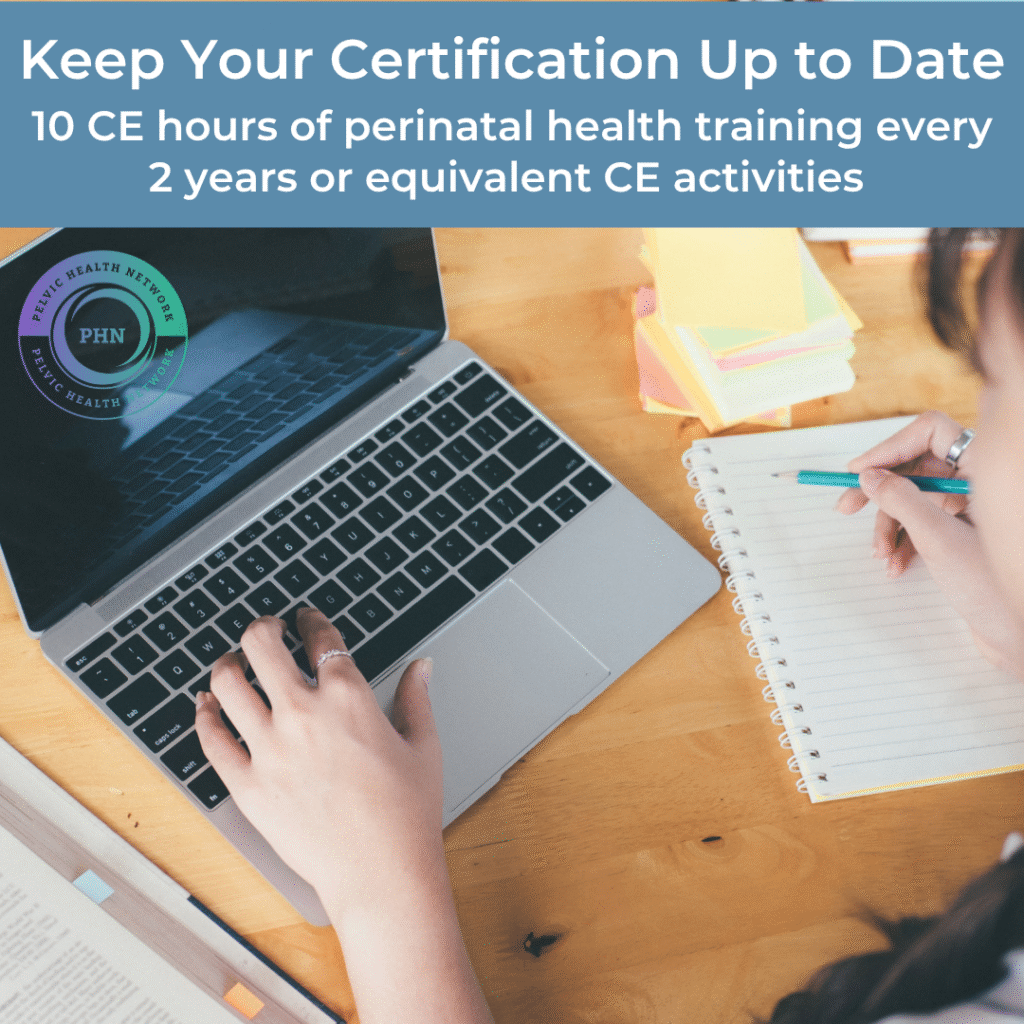
Recertification: 2-Year Cycle
Complete 10 continuing education hours of perinatal health training related to maternal and/or infant health every two years OR an approved equivalent training activity (see 2-Year Recertification Requirements).
PHS-C Applications Now Open
Spring 2026 Cohort: January - June
Fall 2026 Cohort: July - December
2-Year Recertification Requirements
- Complete 10 continuing education hours of perinatal health training related to maternal and/or infant health every 2 years OR any of the following equivalent training activities:
- Accepted manuscript to a peer-reviewed journal on a perinatal health topic: 1 article = 10 CEUs
- Served as the primary or co-presenter on a perinatal health topic at a conference: 1 hour = 2 CEUs
- Primary or co-author of a perinatal health topic in a lay publication e.g. blog/newsletter: 1 article = 2 CEUs
Benefits of a Perinatal Health Certification
What You Get
The confidence to create a system that reduces risk factors immediately after cesarean section, hysterectomy, and more
The techniques to spot concerns earlier and be the point of contact on a person's care team to connect them with resources throughout their first year of recovery
The knowledge to improve perineal and cesarean wound healing and reduce hospital readmissions
The skills to enhance pulmonary, cardiac, and musculoskeletal function in the high-risk pregnancy and postpartum populations
The ability to shorten the recovery process and increase joy in clients who typically wait weeks to months for rehabilitation
The support to improve perinatal mental and physical health outcomes along a continuum of patient-centered care
Meet Our Team
Our Instructors
Our Contributors
Our Directors
Financial Disclosures
Dr. Katherine Sylvester, PT, DPT is the founder of Operation M.I.S.T.
Alexis Brooks, MS, RD is the owner of Alexis Brooks Nutrition.
Nneka Hall is the founder of Mother Is Supreme, Inc.
Dr. Ann Croghan, PT, DPT, CLC is an instructor for Pelvic Health Network.
Dr. Amanda Heritage, PT, DPT is the owner of Breathe Life PT.
Lindsey Vestal, OTR/L is the founder of The Functional Pelvis, the Certified Functional Pelvic Health Practitioner, co-founder of the Trauma-Informed Certification in Pelvic Health, and the co-founder of the OTs in Pelvic Health Summit.
Kelsey Mathias, OTR/L, PRPC is the co-founder of the OTs in Pelvic Health Summit and contributor to the Certified Functional Pelvic Health Practitioner.
Lara Desrosiers, Msc. OT Reg. (Ont) is the founder of Pelvic Resilience, the CEO of AMP Healthcare Education, and the co-founder of the Trauma-Informed Certification in Pelvic Health.
Dr. Rebeca Segraves owns Pelvic Health Network which hosts the educational platform for Enhanced Recovery After Delivery®.
The Experience
Testimonials
Like you, we believe that preventative care should not wait.
Do you believe that individuals after birth should be informed on how to enhance their function immediately after delivery without having to wait and figure out things on their own?
Are hospitals in your community offering OT and PT DAILY after elective surgery (knee and hip replacements) yet not offering therapy ONCE to patients after cesarean section?
Are you a leader in your field, advocating to improve maternal function now to avoid unwanted symptoms later?
You can establish a new standard for care globally by optimizing function after birth and pelvic surgery directly in hospitals, birth centers, and at home where recovery begins.
Frequently Asked Questions
Enhanced Recovery After Delivery® (ERAD) is an evidenced-based pathway that was developed to expand early access to rehab services for families during pregnancy and immediately after birth. We believe that every delivery is unique and that no one can predict how a mother will mentally and physically function after childbirth.
We expedite access to an obstetrics rehab evaluation during every pregnancy and for any birth experience, yet especially in the following instances:
1) during a high-risk pregnancy hospital admission
2) after an unexpected or repeat cesarean section
3) after postpartum hemorrhage following any delivery
4) after an injury to the pelvis, muscles, or nerves that affect mobility
5) after a traumatic perineal tear
6) after a perinatal loss
Enhanced Recovery After Delivery® provides a pathway for offering mothers an obstetrics rehab evaluation during their high-risk pregnancy hospital admission and within the first 24-48 hours after birth prior to hospital discharge. The goal of ERAD® is to maximize pregnancy and postpartum outcomes with occupational and physical therapy before and immediately after childbirth in the hospital and home.
Click HERE to learn how we adapt this training for hospital teams and University health degree programs.
We offer two 6-month hybrid options a year to complete the Perinatal Health Specialist Certification Program: 1) January to June and 2) July to December. You can study at your own pace during this period, yet are provided with 1:1 consultations with an ERAD® instructor and group sessions within your cohort that specifically pertain to your practice i.e. hospital program development or specialized services in your small business and community. Learning within a cohort provides the most accommodations for participants who require time flexibility to self-pace their individualized program development, yet who also benefit from peer and advisor support.
If you have completed the initial 15-hour ERAD® Certificate training and would like to enroll in the Perinatal Health Specialist Certification Program, you can submit your application for the second half of the PHS-C program–Advanced Topics in Acute Perinatal Rehabilitation–HERE.
The Implementation Project is a core component of the ERAD® PHS-C Certification Program. Participants design or expand a maternal rehabilitation service within their own clinical setting while receiving faculty guidance throughout the process.
Implementation Projects focus on improving access to rehabilitation after birth and maternal surgery. Examples include:
• establishing inpatient PT or OT consult pathways after cesarean delivery or obstetric delivery tissue repair
• creating a hospital-to-outpatient postpartum rehabilitation bridge program
• developing home health rehabilitation services for postpartum patients
• launching telehealth recovery programs during the fourth trimester
• building rehabilitation support programs for mothers with infants in the NICU
• implementing functional screening for pregnancy mobility and early postpartum recovery
Projects are designed to match the participant’s practice setting and professional goals.
The PHS-C coursework and certification exam can typically be completed within six months. Participants then continue developing and implementing their project over the remainder of the year.
This timeline allows clinicians to integrate the work into their clinical environment while receiving faculty guidance.
While the PHS-C Implementation Project focuses on clinical implementation and program development, and not formal research, some participants may choose to collect outcome data or present their work in professional settings.
Participants are encouraged to share their work through interdisciplinary education such as:
• hospital in-services
• presentations to OB/GYN teams or nursing staff
• continuing education sessions for rehabilitation clinicians
• community or professional presentations
Teaching helps expand awareness of maternal rehabilitation and supports program sustainability. Graduates join a growing community of clinicians working to expand rehabilitation services for patients recovering from birth and maternal surgery.
You have access to PHS-C program materials for 12 months from the date of your enrollment.
The PHS Certification exam is routinely updated with program materials as labor and delivery medicine continues to evolve. For this reason, you are encouraged to take the exam at the end of your cohort, yet we understand the specific circumstances that arise which prevent this. You can defer the PHS Certification exam one time until the end of the next cohort after your initial enrollment if you do not feel ready to test during your original exam window.
You will be offered an opportunity to apply to re-take the PHS-C exam.
The Perinatal Health Specialist Certification training is appropriate for health professionals who have experience working with pregnant and immediate postpartum populations in the hospital, home, and community. During the program, your 1:1 consultation with an ERAD® instructor will help you identify an appropriate patient that you have demonstrated clinical expertise with for your case study submission. Your case study is required prior to taking the PHS Certification exam. If you are not currently treating the perinatal population during pregnancy or within the first 6 weeks of postpartum recovery, you are encouraged to defer the exam for 6 months until the next exam cycle to gain experience in this area of practice and prior to obtaining the designation of a Certified Perinatal Health Specialist to treat this unique patient population.
Enhanced Recovery After Delivery® offers The Trauma-Informed Maternal Health Scholarship, sponsored by Lindsey Vestal, OTR/L, founder of The Functional Pelvis and Pelvic Health Network member discounts. Our scholarship program is designed to reduce the financial burden of the program for eligible applicants who are making a powerful impact in maternal and infant health. Creatively expressing your unique value is a must. For more information on our scholarship program, click HERE.
Additional questions? Email us at info@pelvichealthnetwork.org